
Thermal Hazards
Heat and/or Fire — Sources and Heat Transfer
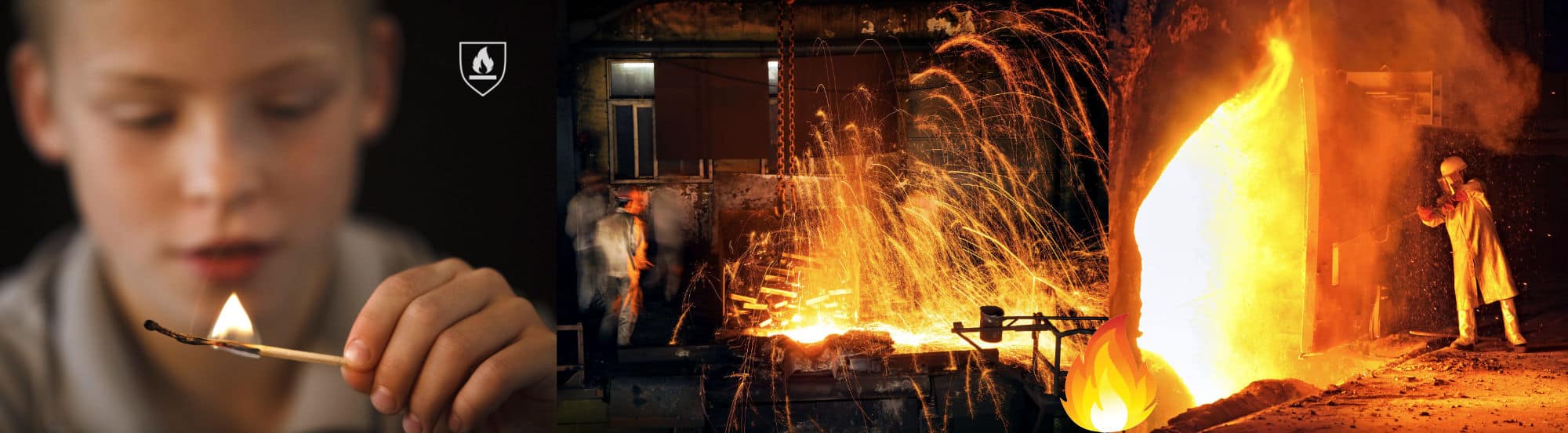
Thermal hazards in industry arise from technological processes operating at high temperatures, from which heat is transferred by radiation, convection or conduction. Hazards also arise from direct contact with hot objects. Extreme radiant and contact heat, open flames, splashes of molten material and hot particles threaten people’s safety in demanding industrial environments, making effective protection essential.

The heat source is electrical energy or combustion — a rapid oxidation reaction that produces a flame (a column of burning gases) and releases heat and light. Combustion requires fuel and an oxidising agent in a ratio that supports ignition. The oxidising agent (a substance that supports combustion) is usually oxygen in the air. The oxygen concentration determines the degree of flame resistance of textiles. Flammability is determined by the LOI (Limiting Oxygen Index), also known as LKČ in Slovak (limiting oxygen index), which indicates the minimum oxygen concentration at which a material burns. The oxygen content of the atmosphere is just under 21%, and this determines flammability. Materials with an LOI >21 are considered non-flammable (flame-resistant), while those with values of LOI<21 are classed as flammable. The higher the LOI, the greater the material’s resistance to ignition and burning. For example, cotton has an LOI of 18–20, para-aramid approximately 31 and PBI™ 38.
Limited Flame Spread

In industrial environments, exposure to flames is relatively uncommon and usually occurs alongside other types of thermal hazard. Flames and combustion are the main hazards faced by firefighting crews. The standards and equipment requirements for firefighters are therefore separate from the requirements for industrial PPE (personal protective equipment).
Requirements for protective clothing are set out in EN ISO 11612, using the test method in ISO 15025. The material is exposed to a gas-burner flame at a distance of 20 mm, at an angle of 90° or 30°, for 10 s, using two test methods:
A1: ignition and burning on the surface;
A2: ignition and burning at the edgeof the material.
The material must not burn across its surface or edges, form holes, melt or produce molten droplets. The mean afterflame and afterglow times must be less than 2 s.
Limited burning and flame resistance of gloves are specified by EN 407, using the test method in EN ISO 6941. The material is exposed to a flame at a distance of 20 mm for 15 s. Once the flame is removed, the duration of burning, afterflame and afterglow is measured in seconds. Four protection levels are distinguished:
1: afterflame ≤ 20 s; no afterglow requirement;
2: afterflame ≤ 10 s; afterglow ≤ 120 s;
3: afterflame ≤ 3 s; afterglow ≤ 25 s;
4: afterflame ≤ 2 s; afterglow ≤ 5 s.
Contact Heat
Contact heat is one of the main hazards in hand protection and must be distinguished from convective and radiant heat. In our many years of experience, we have often received requests for “gloves for temperatures up to 1000°C”. When we analyse such requests, we find that the process operating temperature is indeed around 1000°C (a technological process inside an enclosed furnace), but the maximum contact temperature measured during handling is approximately 250–300°C, accompanied by intense radiant heat and a risk of molten-material splashes. We can usually address this using aluminised gloves from our “basic” Series 400, which are suitable for more than 95% of applications.
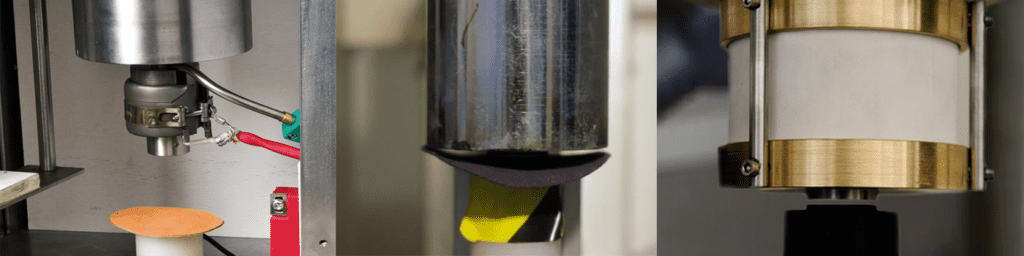
Contact heat protection for clothing is covered by EN ISO 11612 in the CONTACT HEAT section. The test method is specified in ISO 12127: the material (horizontally positioned circular specimens, 80 mm in diameter) is exposed to a contact temperature of 250°C using a heated cylinder with a contact-surface diameter of 25 mm. The time required to reach the pain threshold (damage to the PVC film) is measured. Results are designated by code F, with three performance levels:
F1: 5<10 s; F2: 10<15 s; F3: 15 s and above.
Protection for gloves is specified in EN 407, using the test method in EN 702. The material (or the combination of materials used to make the gloves) is exposed to four contact temperatures, which also define the protection levels:
1: +100°C; 2: +250°C; 3: +350°C; 4: +500°C.
The test is carried out under precisely defined conditions (contact area and applied pressure). The time required for the temperature on the opposite side of the specimen (inside the glove) to rise by 10°C is measured. The initial reference temperature is approximately 25°C. The minimum acceptable measured time for meeting the relevant requirement is 15 s.
Convective Heat — Flame

Convection, or heat transfer by fluid movement, is one of the basic mechanisms of heat transfer. From a physical perspective, it is particularly important in liquids and gases, where relatively free particles with different levels of thermal energy move.
Convection is based on the fact that a substance’s density changes with temperature, particularly in gases. Under the influence of gravity, this causes natural flow, mixing and the equalisation of temperatures. Convection can be divided into natural convection (physical laws: heat rises) and forced convection (fans, stirring liquids, etc.).
EN ISO 11612 (for clothing) defines three performance levels for protection against convective heat, using the test method in ISO 9151. These are determined by the Heat Transfer Index (HTI), measured for individual materials or combinations of materials. Specimens measuring 14 × 14 cm are positioned horizontally above a gas burner with an output of 80 kW/m2. A calorimeter then measures the heat passing through the specimen. The result is the average of three measurements of the time required for the temperature on the opposite side of the specimen to increase by 12°C or 24°C. HTI12 correlates with the perception threshold, while HTI24 correlates with the pain threshold. The time for HTI24 determines the protection levels:
B1: 4<10 s; B2: 10<20 s; B3: 20 s and above.
EN 407 (for protective gloves) specifies performance levels for protection against convective heat (test method EN 367) using the threshold time, which is the time required for a temperature rise of 24°C on the inside of the glove (a combination of materials, specimen size 140 × 140 mm). The test requires heat generated by a gas burner with an output of 80 kW/m2.
For gloves, four levels of protection are defined:
1: ≥ 4 s; 2: ≥ 7 s; 3: ≥ 10 s; 4: ≥ 18 s.
In simple terms: the time for convective heat (flame) to reach the inside of the glove or garment and cause pain.
Radiant Heat
Radiant heat, also known as thermal radiation, is one of the basic mechanisms of heat transfer and the only one that does not require a material medium. Heat is emitted and travels through the surroundings (air) with almost no loss until it encounters a solid object. This partly reflects and partly absorbs the heat, causing its temperature to rise. Different materials absorb radiant heat differently: dark, rough objects heat up more and faster than shiny, smooth objects.

For protection against radiant heat, the most effective choice is textiles with an aluminised surface. The shiny layer reflects a substantial proportion of the radiation, depending on the surface quality, so the material heats up only slowly. Modern technology provides several ways of aluminising textiles. The final quality depends on several factors, including:
- the thickness and structure of the textile;
- the carrier material for the aluminium pigment (Mylar, polyester, aluminium foil, etc.) and its thickness;
- the adhesives used (silicone, polyurethane, etc.);
- the lamination technology and precision.
The measurement method is defined in EN 6942, which uses the Radiant Heat Transfer Index (RHTI) as a parameter for assessing test results. When testing specimens measuring 230 mm × 70 mm, the radiant heat flux density is precisely specified. Lower intensity can be compensated for by a longer exposure time, and vice versa. The test method distinguishes two procedures:
Method A describes visual changes in materials exposed to radiant heat.
Method B measures the time, in seconds, required for a temperature rise of 12°C or 24°C. A calorimeter measures the temperature increase on the reverse side of the textile, determining RHTI12 or RHTI24 at a radiant heat flux density of 20 kW/m2.
There are four performance levels for clothing (C), using HTI24:
C1: ≥ 7 s; C2: ≥ 20 s; C3: ≥ 50 s; C4: ≥ 95 s;
and four protection levels for gloves, using HTI24:
1: ≥ 7 s; 2: ≥ 20 s; 3: ≥ 50 s; 4: ≥ 95 s.
In simple terms: the time for radiant heat to reach the inside of the glove or garment and cause pain.
Molten Metal

Assessment of textile resistance to large splashes of molten metal is covered by EN ISO 9185, which specifies a test method for determining resistance to heat penetration through textiles under this hazard.
Molten metal (aluminium at 780°C or iron at 1400°C) is poured in the warp direction from a height of 225 mm onto a textile specimen measuring 260 mm × 100 mm, inclined at 60° for aluminium or 75° for iron. A PVC film simulating skin is placed directly beneath the specimen. The test is assessed by changes (damage) to the PVC film. Depending on the result, the test is repeated using a larger or smaller quantity of metal until the critical mass that damages the film has been determined.
Protective clothing uses three performance levels for aluminium (D):
D1: ≥ 100 g; D2: ≥ 200 g; D3: ≥ 350 g;
and three levels for iron (E):
E1: ≥ 60 g; E2: ≥ 120 g; E3: ≥ 200 g.
For gloves, four levels of protection against molten iron are distinguished:
1: ≥ 30 g; 2: ≥ 60 g; 3: ≥ 120 g; 4: ≥ 200 g.
The test method for assessing materials used to protect against small splashes of molten metal is specified in EN 348 (Test method: determination of the behaviour of materials on impact of small splashes of molten metal). This glove test is based on determining the total number of drops of molten metal needed to raise the temperature on the inside of the glove by 40°C (the pain threshold). For iron, four levels of protection are distinguished:
1: ≥ 5; 2: ≥ 15; 3: ≥ 25; 4: ≥ 35.
Burns and First Aid
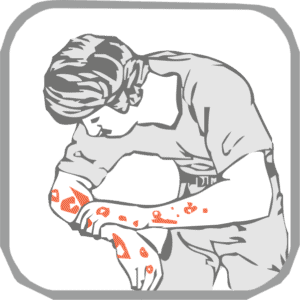
A burn (Latin: combustio) is an injury that results from exposure to heat and hot substances in solid, liquid or gaseous form acting on the skin and superficial mucous membranes. This can cause tissue damage of varying severity, depending on the type, intensity and duration of exposure. Injuries are classified as first- to fourth-degree burns.
- Immediately remove the source of heat and cool small affected areas with cold water (not on open wounds) for approximately 20 minutes.
- Once the pain has subsided, cover the burn with sterile gauze if possible, a gentle cooling dressing, or simply a clean cloth.
- Carefully and as soon as possible, remove watches and rings from the injured limbs, before they begin to swell.
- Never pull off burnt clothing; remove only clothing that is not stuck to the skin.
- Do not apply powders or ointments to wounds.
- Take measures to prevent shock:
Quiet — Warmth — Fluids — Pain relief — Transport (for professional medical care).

COME IN – OUT OF THE HEAT
For more than 30 YEARS, we have been providing our clients with professional, effective, reliable and safe PROTECTION AGAINST THERMAL HAZARDS.
We offer solutions and experience gained throughout a period in which we have recorded no failures or lapses in protecting people in industrial environments.

